Who invented ai history
Artificial Intelligence, termed as the technology of the future, was never an invention of a single moment or a solitary genius. Rummage through history and you’ll dive deep into a swirling pool of ideas, sporadic sparks of brilliance, and birth of disciplines that lit the torch we today call AI.
The story of its inception is not a eureka moment or rooted to one brilliant mind, but rather a timeline of intellectual evolution that transcended centuries. This article unravels that tightly-knit edifice, revealing the foundational juggernauts and the revolution they ignited. We’ll ditch the notion of a ‘birth date’ or a ‘founding father’, showcasing instead the harmonious dance of scientific progress across boundaries and disciplines.
From Ancient Concepts to Foundational Ideas: AI’s Intellectual Predecessors
Long before Artificial Intelligence became the towering technoscape it is today, humankind grappled with thoughts and questions that necessitated its existence. Early intellectuals like Aristotle envisioned systems of logical reasoning, foreshadowing the algorithms that fuel AI today. Clear parallels can be drawn from Aristotle’s syllogistic logic — a form of logical argument that applies deductive reasoning to arrive at a conclusion based on two or more propositions assumed to be true — to the core of machine learning: making decisions based on recognized patterns.
The 13th-century philosopher, Ramon Llull, too had his share in AI’s prehistory. He dreamt of ‘logical machines’, theoretical devices capable of generating knowledge. One could argue that these logical machines were embryonic forms of today’s computational systems, whose amalgamation eventually spelled ‘AI’.
However, Descartes arguably shaped our understanding of IA the most. His take on the mind-body problem — asserting that mental phenomena are, in some respects, non-physical — initiated debates around consciousness and artificiality that form the philosophical backbone of AI. The question of replicating human intelligence hence isn’t as much a scientific quest as it is an age-old philosophical probe, which resurfaced with AI’s advent.
These intellectual voyages into the nature of thought, logic, and consciousness have been the stepping stones of computing’s grand journey. When tracing the lineage of AI, we mustn’t overlook this rich heritage. For every achievement in AI is but an echo of these ancient ponderings manifesting in silicon.
Pioneers in Computing and Logic: Babbage, Boole, and Shannon
The path to artificial intelligence is founded upon critical leaps in computation and logic. Let’s touch upon these significant milestones:
- Charles Babbage and Ada Lovelace made the concept of algorithms conceivable with their Analytical Engine, heralding a new era of computational possibilities.
- George Boole’s contribution cannot be overstated, with Boolean Logic emerging as the true language of computation and forming the bedrock of modern digital systems.
- Claude Shannon’s Information Theory, translating data into digital representation, amplified the potential of electronic computation.
These trailblazing individuals established the principles that breathed life into the idea of AI – one that we continue to explore and evolve today.
World War II: The Hotbed of Information Revolution
War, as grim as it may seem, often pushes societies into a crucible, igniting technological progress. World War II laid the foundational stones for the future artificially intelligent world. At this juncture, necessity indeed became the mother of invention.
With the escalating conflict, decoding enemy communications became crucial for survival. This urgency took cybernetics, a discipline focusing on feedback, systems, and control, from a theoretical frontier into practical applications, placing it on humanity’s strategic map. Norbert Wiener’s key role in the development of cybernetics should be highlighted here. His work revealed how feedback loops could illustrate intelligent behavior, providing a fresh perspective on automation.
Around the same period, Warren McCulloch and Walter Pitts sparked the beginning of research in neural networks. Their early work paved the way for more sophisticated models that form the backbone of modern AI’s learning dynamics.
World War II, thus, inadvertently played a catalytic role in swelling the tide of advanced computation and complex systems. As we unwrap the layers of AI’s history, it becomes abundantly clear that this war-ridden time indeed primed the stage for subsequent leaps in artificial intelligence.
Turing’s Legacy: Shaping the Foundation of Artificial Intelligence
Alan Turing’s name echoes resoundingly when examining who invented AI history. Turing’s thinking machine conceptually tinkered with the notion of ‘computability’, introducing the world to the idea that machines could embrace logic and solve problems in a human-like manner.
In Turing’s universe, his hypothetical machine didn’t just compute—it “thought”. This ambitious idea shook the foundations of then-prevailing consensus, expanding the horizons for what machines might achieve. This revolutionary vision became a cornerstone for the conceptual structure of artificial intelligence.
Turing’s theoretical explorations were not confined to the concept of a thinking machine alone. His ‘Imitation Game’, widely known as the Turing Test, attempted to define machine intelligence by their ability to mimic humanlike responses. It is as if Turing invited machines to a conversational ball, set the steps, and then judged their dance against the human benchmark. The impression of this test has endured, and continues to influence the definition of machine intelligence even today.
Intertwined with Turing’s vision for machine intelligence was an element of learning—a mechanism for machines to evolve their problem-solving abilities progressively. Implicitly, Turing laid the groundwork for the concept of machine learning often seen as the engine behind modern AI systems.
Turing’s vision was, thus, fundamental in sculpting the landscape of artificial intelligence as we understand and interact with it today. His pioneering thoughts have left an indelible mark on the AI timeline, validating the view that pioneering breakthroughs rarely occur in isolation but emerge from the collective crescendo of past explorations.
A Gathering at Dartmouth: AI Finds Its Name and Path
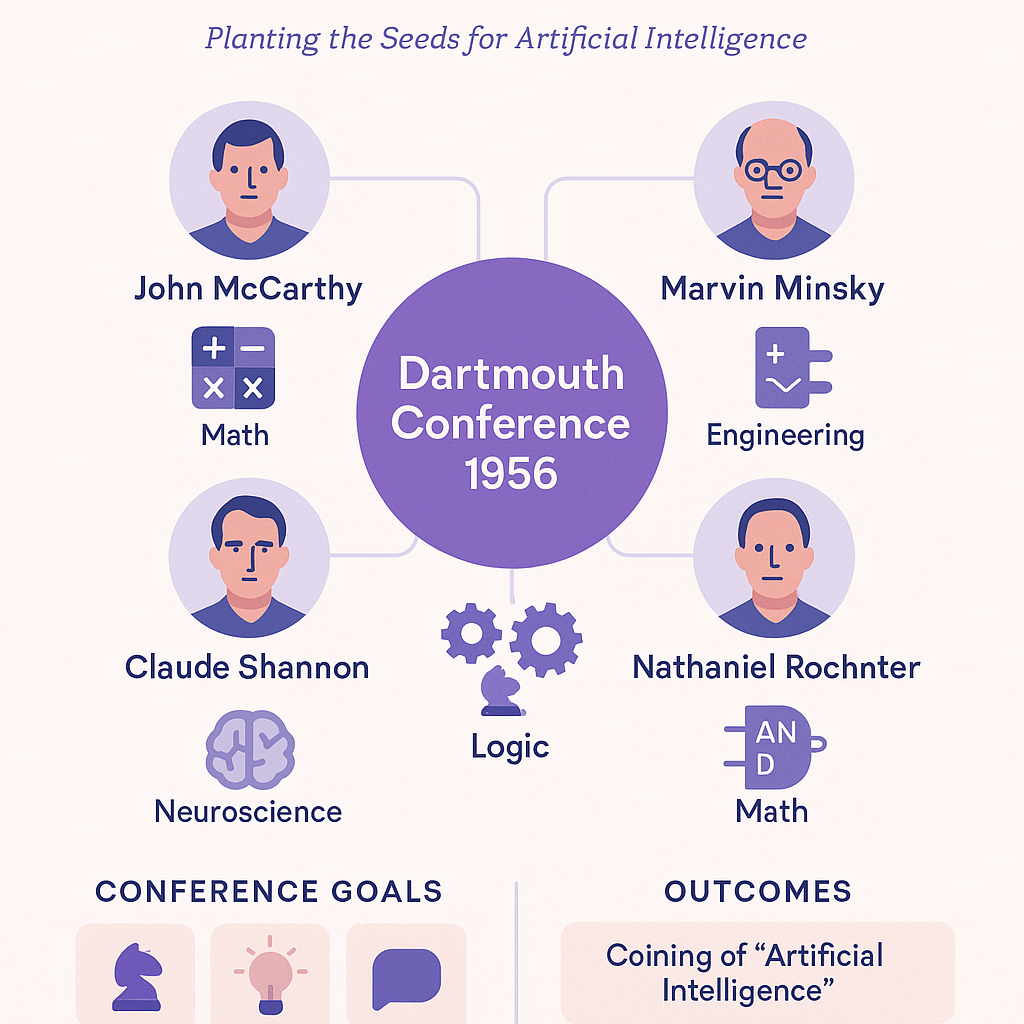
In the summer of 1956, a landmark event in the history of artificial intelligence took place. This historical gathering, the Dartmouth Summer Research Project on Artificial Intelligence, was more than just a conference – it was the baptism of artificial intelligence as a field of study, and a vision statement for its future.
John McCarthy, Marvin Minsky, Nathaniel Rochester, and Claude Shannon – these were the pioneers who charted the map of this novel discipline. They didn’t just introduce the term ‘Artificial Intelligence’; they also defined its wide realm of research, from symbolic reasoning and problem-solving to natural language processing. Their ambition was as vast and profound as the field they envisaged.
The optimism that prevailed at the Dartmouth conference literally inked the blueprint of AI’s journey in the coming years. It echoed a collective belief in the inherent potential of machines to simulate human intelligence. Reflecting on the outcomes of this conference is almost like peering into a beacon from the past, illuminating the cradle of the AI era.
This seminal meeting and subsequent collaborations are a testament to how the synergy of emphatic ideas and determined minds can shape the trajectory of a discipline, leaving a profound imprint on the pages of history. Time has remarkable ways of transforming ambition into reality, and the Dartmouth conference bears a striking testament to this fact. Through this lens, we appreciate the roots of artificial intelligence and the pioneers behind its scientific evolution.
Trailblazers of Code: Major Programs Shaping Early AI
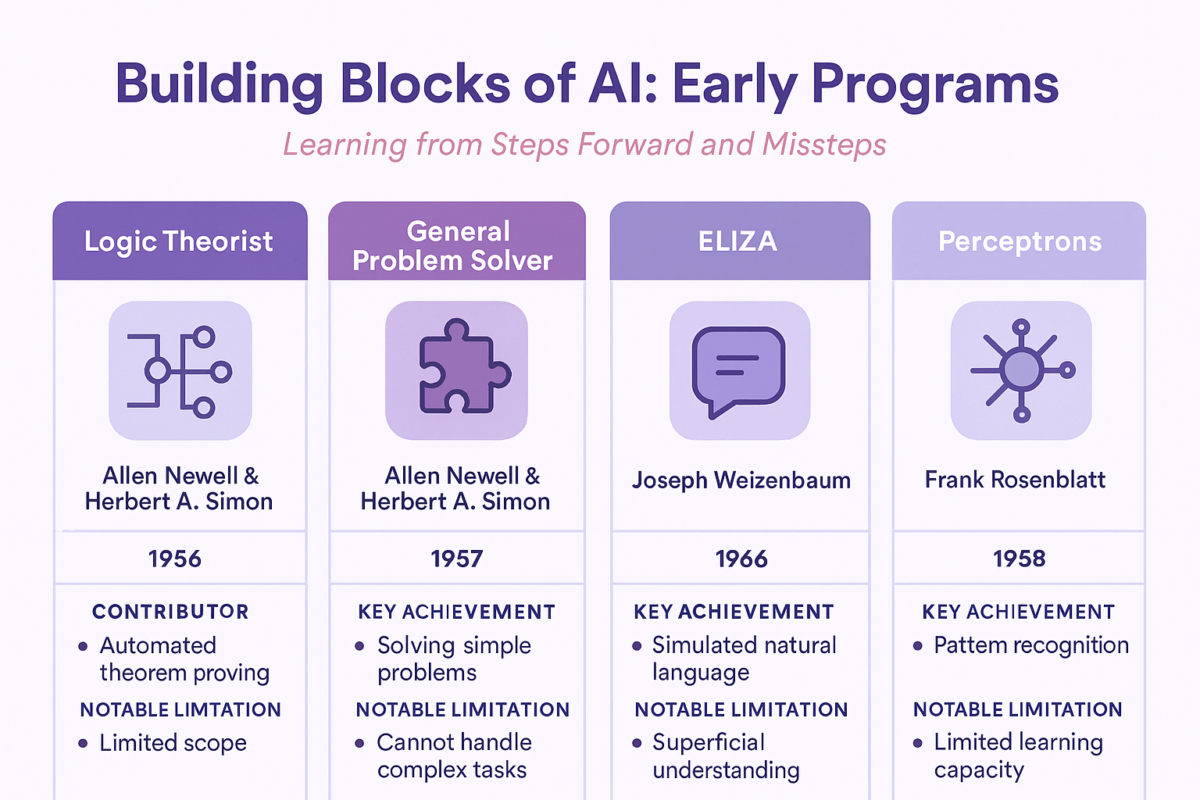
Let’s turn our attention to the pivotal programs that significantly shaped the realm of AI during its formative phase. Each program was unique, contributing its own blend of triumphs and tribulations to the tapestry of the budding AI science.
| Program/Concept | Key Contributor(s) | Year | Significance/Contribution |
| Logic Theorist | Allen Newell, Herbert A. Simon, Cliff Shaw | 1956 | The first AI program, capable of mimicking human problem-solving. It spurred the development of AI, even solving problems that stumped human logicians. |
| General Problem Solver (GPS) | Allen Newell, Herbert A. Simon | 1957 | Promised to solve any problem expressed as a set of well-defined steps. Though idealistic, its limitations spotlighted the complexity of human cognition. |
| ELIZA | Joseph Weizenbaum | 1966 | An early natural language processing computer, simulating human conversation. It fascinated many, despite lacking any understanding of the chats it partook in. |
| Perceptrons | Frank Rosenblatt | 1957 | The first machine learning model, capable of binary classifications. It laid groundwork for neural networks, though the hype outweighed its actual capabilities, contributing to the onset of the ‘AI Winter’. |
These programs played a significant role in shaping the direction and perception of AI research – foreshadowing the vast capabilities and potential pitfalls of designing machines to emulate humanity. We stand today at the intersection of their visionary contributions and the reality of present-day artificial intelligence.
Summarizing Insights: The Genesis of AI
While it’s tempting to attribute the birth of artificial intelligence to a singular event or individual, the truth is far more intricate. Its origins unravel into an array of contributions from numerous disciplines, each enriching the science of AI from its distinct perspective. Areas like mathematics, logic, psychology, philosophy, and computer science all offered profound insights that eventually culminated into what we now know as AI.
These complex threads, interwoven over time, demonstrate the content-rich journey of this field’s development. The idea of AI was not conjured up overnight. Instead, it matured through rigorous research, countless experiments, and continuous refinements that converted an abstract idea into a formal area of study.
Pondering AI’s Continous Growth: Beyond History and Towards the Future
Whether it’s looking back at early conceptual breakthroughs or acknowledging the pioneers who struggled against the odds, understanding the intricate history of AI allows us to fully comprehend the advancements we currently witness. The story of AI is not finished but it forever evolves, shaped by the challenges we face and the collective solutions we devise.
We are all participating in AI’s ongoing journey. Whether as scholars, engineers, students, or simply curious minds, we’re shaping the narrative of AI’s present and its future. So, let’s keep uncovering the lessons that the past offers, whilst actively contributing to the rapidly evolving tapestry of AI’s future.